Product
Marine sewage treatment plant (Sea Clean Series)
Electrolytic sewage treatment plant, Biochemical sewage treatment plant

- 홈
- Product
- Water treatment system
Water treatment system
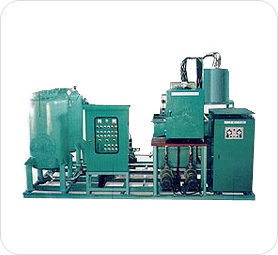
Wastewater Electrolytic Treatment System (EST)
- Processing speed is fast (stay time: 5-10 minutes)
- It is resistant to organic load fluctuations.
- Low sludge generation rate (1/2 of active sludge method)
- The required site is small (1/3 of the active sludge method)
- It is easy to treat non-degradable wastewater (heavy metal, oil, etc.).
- There is no infusion of medicine.
- It's automated and uncomplicated.
- It is also possible to install the process of the existing installation process (AFTER).
(the preliminary feasibility to strengthen legal standards after 2000)
Product information
Product specifications
| Sortation | EST SYSTEM | ||
|---|---|---|---|
| Inflow (mg/l) | Spill (mg/l) | Removal rate (%) | |
| BOD5 | 476.0 | 15.3 | 95.9 |
| CODMn | 372.0 | 9.5 | 97.4 |
| SS | 343.0 | 8.6 | 97.5 |
| N-H | 237.8 | 2.8 | 98.9 |
| T-N | 115.0 | 30 | 73.9 |
| T-P | 58.0 | 12 | 101호 |
Theoretical principles of electrolysis treatment
In the electrolysis treatment, when electric energy is supplied through the electrode plate to the organic wastewater containing electrolytes (Seawater, NaCl), electron is directly exchanged at the interface between the electrode and the solution The wastewater is treated by an electrode reaction of oxidation, reduction and decomposition, and precipitation, and an oxidation reaction by hypochlorous acid (HOCI) and ozone (O3), which are reaction products. Sodium chloride After electrolysis treatment, the strong sterilization power of hypochlorous acid generated on the electrode surface causes oxidation to the organ wastewater, which is purified and sterilized. And it is generated during electrolysis Due to the rise of fine hydrogen gas, floating solids and colloidal suspended substances in water are separated and treated.
Comparison with other methods
| Sortation | Active sludge method | R/O system | S.B.R | Electrolytic treatment system |
|---|---|---|---|---|
| Principle | Organic matter control using microorganisms | Reverse osmosis | Accompanied by reaction, precipitation, etc. in one reaction tank | Electrolysis |
| Response to load changes | If inflow and water quality fluctuations are large, efficiency is likely to decrease | Strong against load fluctuations | When installing the automatic control system, it is resistant to load fluctuations within a certain range | Strong against load fluctuations |
| Nutritional Salt Removal | The conditions such as the ratio of C:N:P must be met. | Have an excellent removal rate | Have a relatively good removal rate | Have an excellent removal rate |
| Conditions of the site | A large site is required because a reaction tank and a precipitation tank are required. | As there are no civil engineering structures other than flow control tanks, less land is required | Reaction and precipitation take place in one tank, so relatively little | The reaction time is within 10mm, so it takes very little space |
| Merit | The installation and operation costs are low. | Easy to operate and small site area. It is advantageous for small and non-degradable wastewater. | Power can be minimized by controlling the reaction time according to the flow rate | Easy to operate and small site area. It is advantageous for small, non-degradable wastewater. |
| Weakness | Driving conditions are difficult and a separate nutrient salt removal facility is required | The cost of membrane replacement is the largest in the event of faulking, depending on imports for parts that are not produced in Korea | A rear-end facility is required to adapt to a high-concentration organic material treatment system. | Drugs should be injected into wastewater that lacks electrolytes. |
Applicable field
Organic chemical factory wastewater / Inorganic chemical factory wastewater / Dyeing factory wastewater / Plated factory wastewater /
Livestock wastewater / Petrochemical wastewater / Sewage thin manure treatment
Technology and certification status
Development and patents: In-house technology development, two patents held, and quality certification: 1997. Prime Minister's Award for Excellent Capital Redevelopment / Environmental Management Corporation Certification New Environmental Technology